Muhammad Ahsan, PhD, Engr.
Researcher in Advancing Structural Health Monitoring and Intelligent Fault Diagnosis
SCADA-based condition monitoring and fault detection of wind turbines
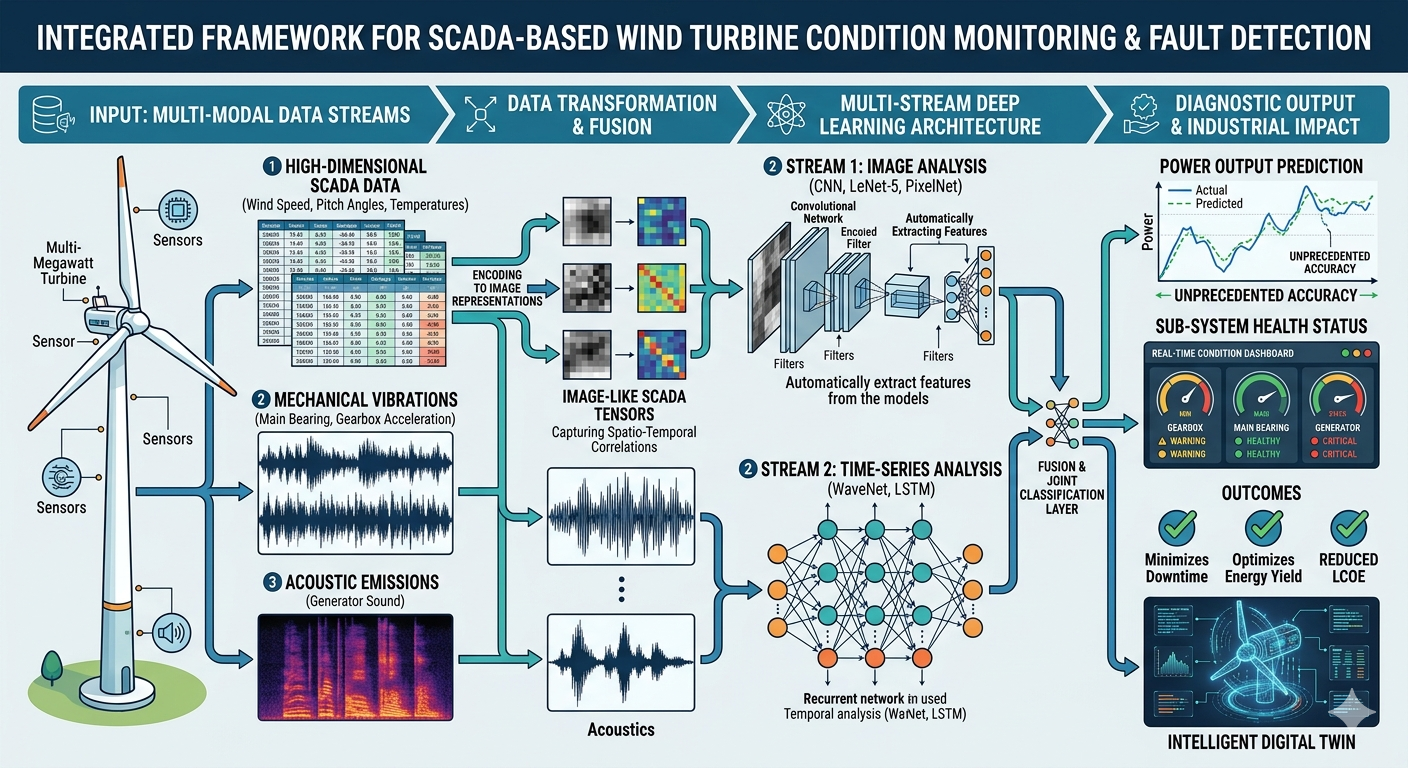
Development of an integrated framework for SCADA-based condition monitoring and fault detection of wind turbines, incorporating image analysis and trend monitoring techniques.
Description
As the global energy transition accelerates, wind energy reliability is paramount. This research proposes an integrated framework for wind turbine power prediction and multi-subsystem health monitoring using high-dimensional SCADA (Supervisory Control and Data Acquisition), vibration, and acoustic data. By merging multi-modal sensor streams with advanced deep learning, the project aims to minimize downtime and optimize energy yield.
The core of this methodology involves transforming multi-sensor SCADA data—encompassing wind speed, pitch angles, and temperatures—into high-dimensional tensors and 2D image representations. This transformation enables the application of computer vision-inspired architectures to capture complex spatio-temporal correlations that traditional time-series models often overlook. By encoding tabular data into image-like structures, we can leverage the feature-extraction power of deep architectures to predict power output with unprecedented accuracy.
The research employs a multi-stream deep learning approach, utilizing CNN, LeNet-5, and PixelNet for image-based SCADA representation, complemented by WaveNet and LSTM models for time-series analysis of mechanical vibrations and acoustics.
By integrating heterogeneous data sources into a unified diagnostic platform, this work provides a scalable solution for offshore and onshore wind farms. The results contribute to the development of intelligent Digital Twins, enhancing the sustainability and economic viability of wind energy infrastructure through reduced Levelized Cost of Energy (LCOE).
Project Resources
Publications
Code & Data
Funding & Support
This research was supported by:
Grant Agency Name
IDUB Project Code: 501.696.7996
"Excellence Initiative – Research University (IDUB) Programme of the AGH University of Krakow"
© Muhammad Ahsan 2026.